Clear Vision, Healthy Eyes: Laser Correction, Glaucoma Myths & the Eye Check at 40
Dr Philemon Huang, Senior Consultant Ophthalmologist
LASIK, SMILE Pro, TransPRK or ICL? How I Help Patients Choose, as an Eye Surgeon Who Has Had Laser Vision Correction Myself
By Dr Philemon Huang, MBBS (S’pore), MMed (Ophth), FAMS, FRCOphth | Senior Consultant Ophthalmologist
Like many of my patients, I lived most of my life with myopia.
In 2021, I had TransPRK myself. It let me experience the procedure and the recovery through the eyes of a patient, not just the surgeon. My recovery went smoothly. I was able to let go of the daily reliance on spectacles, and rediscover the simple joy of waking up each morning to clear, natural eyesight.
So when patients sit down in my clinic and ask, “Doctor, which one is the best?”, I understand the question very well.
Here is my honest answer. There is no single best procedure. There is only the one that suits your eyes.
Two patients of mine show why.
The first was a 38-year-old woman with high myopia and astigmatism, roughly -7 to -9 with about -3.5 of astigmatism. Correcting that much means removing more corneal tissue, and her corneas simply didn't have enough for SMILE Pro. We discussed ICL. She didn't like the idea of a procedure inside the eye, and the cost was higher than she wanted. So she went with TransPRK combined with corneal cross-linking (CXL) in both eyes. By about three weeks she was seeing 6/6 in both eyes, with no haze.
The second was a 29-year-old man, about -5.50 to -6.00. His priority was different. He had a wedding fair the very next day and needed to be functional quickly. His measurements suited SMILE Pro, so that is what he had, the day after his assessment. The morning after, he was seeing 6/7.5, close to normal, and 6/6 by day six.
Two different people, two different procedures, and both were the right choice for them. (Results vary from person to person, and these are not a promise for your eyes.)
First, what each option actually does
All four procedures aim for the same thing: getting light to focus properly on the retina so you can see clearly without glasses. They just work in different places.
LASIK. A thin flap is created on the front of the cornea and lifted. A laser reshapes the tissue underneath, and the flap is put back. Visual recovery is usually very quick.
SMILE Pro. There is no flap. A laser shapes a thin disc of tissue (a “lenticule”) inside the cornea, and the surgeon removes it through a small keyhole opening. Studies have shown that the smaller opening helps preserve more corneal nerves, with a lower risk of dry eyes.
TransPRK. This is a surface treatment, and it’s the one I had. The laser works on the surface of the cornea in a single no-touch step, with no flap and no cut. Because the surface skin of the cornea needs to grow back, the first few days of recovery are generally slower and more uncomfortable than with LASIK or SMILE Pro.
ICL (Implantable Collamer Lens). This one doesn’t reshape the cornea at all. A thin lens is placed inside the eye, in front of your natural lens. It’s often considered for higher prescriptions, or when the cornea is too thin for laser treatment. Because it is surgery inside the eye, it comes with its own risks and needs long-term follow-up.
Think of it like getting a suit altered. LASIK and SMILE Pro take it in from the inside seams, TransPRK works on the outer fabric, and ICL leaves the suit alone and adds a well-fitted lining. All of them can give you a good fit. But which one a tailor chooses depends on the cloth he has to work with.
What really decides it: your eyes, not the brochure
I want to bring your attention to one thing. The decision is mostly made by measurements, not by preference.
At a proper suitability assessment, we look at:
- Your prescription. How much myopia, astigmatism or long-sightedness there is, and whether it has been stable.
- Corneal thickness and shape. Laser procedures remove a small amount of corneal tissue. If the cornea is thin or has an irregular shape, some options become unsafe, and a lens-based option like ICL may be considered instead.
- Your tear film and dry eye. Dry eye before surgery tends to matter after surgery. This can tilt the decision towards a flapless option.
- Your work and lifestyle. If you play contact sports such as soccer, rugby or martial arts, or in dynamic jobs such as the military, may find surface treatments like TransPRK more suitable because there is no flap to be dislodged.
- Your age. From around 40, reading vision starts to change (presbyopia, or “lao hua”). Correcting your distance vision won’t stop that. It’s worth discussing before surgery, not after.
- The health of the rest of your eye, including your retina and your optic nerve.
That last point is close to my heart. My training is in glaucoma as well as refractive surgery, so I pay close attention to the optic nerve before any vision correction. Myopia is itself a risk factor for glaucoma. The Glaucoma Research Foundation also points out that eye pressure readings tend to read lower after laser vision correction, because the cornea is thinner. So the time to get a clean baseline of your eye pressure and optic nerve is before surgery. (I’ve written more about this in a separate article on what laser vision correction does and doesn’t change.)
“My friend did SMILE, so I’ll do SMILE”
You might be thinking this. Many people do.
Your friend’s eyes were measured, and the result suited your friend. Your cornea might be thicker or thinner. Your prescription might be higher. Your friend might play badminton on weekends while you play rugby, or the other way round. Choosing a procedure because it worked for someone else is a bit like borrowing their spectacles. They are excellent spectacles. Just not for you.
The same goes for online reviews and price comparisons. They tell you what someone else experienced. They can’t tell you what your corneal scan shows.
Timing matters too
People often ask me whether there’s a “right age” for laser vision correction. There isn’t a perfect one, but there are a few principles.
Your prescription should be stable. If your myopia has still been creeping up over the past year or so, it’s usually wiser to wait, otherwise you could be correcting a moving target. That’s why most clinics look for adult patients whose prescription has settled.
At the other end, if you’re in your 40s, presbyopia is already on its way, and your plan should take that into account. Some people in this age group are better served by a different approach altogether, and a good surgeon will raise this with you rather than wait for you to discover it.
And if you’re planning a pregnancy, or you’re pregnant or breastfeeding, mention it. Hormonal changes can affect your prescription and your tear film, so timing may need to shift.
A quick comparison, in plain words
| What it does | Flap? | Early recovery (general) | Often considered when | |
|---|---|---|---|---|
| LASIK | Reshapes cornea under a flap | Yes | Usually very quick | Cornea suitable, no strong reason to avoid a flap |
| SMILE Pro | Removes a lenticule through a keyhole | No | Usually quick | Myopia with or without astigmatism, dry eye concerns, contact sports |
| TransPRK | Reshapes the corneal surface, no-touch | No | Slower and more uncomfortable for the first few days | Thinner corneas, contact sports or uniformed jobs, preference for no cut |
| ICL | Places a lens inside the eye | No (no corneal reshaping) | Usually quick | Higher prescriptions, thin corneas, not suitable for laser |
This is a general guide only. Exact suitability ranges differ between machines and clinics, and your surgeon should explain the ones that apply to you.
Every option has trade-offs
I would not be doing my job if I only talked about the upside.
Laser procedures can cause dry eyes, glare or halos, especially in the early months. These usually settle, but not always completely. Surface treatments like TransPRK involve a few more days of discomfort at the start. LASIK carries flap-related risks, which are uncommon. ICL is surgery inside the eye, so it needs suitable internal measurements and regular check-ups afterwards.
And sometimes the right answer is no surgery at all. If your prescription is still changing, your cornea isn’t suitable, or there’s an eye condition that needs treating first, a good assessment should tell you so. That isn’t a failed consultation. It’s a successful one.
Sometimes the assessment finds something else entirely. I once saw a 31-year-old man who came in for a routine laser vision correction assessment and turned out to have glaucoma. He had no idea.
Questions to ask at your assessment
Write these down and bring them along:
- Which procedures am I suitable for, and which am I not suitable for? Why?
- What did my corneal thickness and shape scans show?
- Do I have any dry eye, and how will that be managed?
- Has my optic nerve been checked, and what is my baseline eye pressure?
- How will my reading vision change after 40, and does that affect my choice now?
- What does recovery look like for my job and my sports?
- What follow-up will I need, and for how long?
If your questions are answered clearly, without pressure, you’re in good hands. If you feel rushed, it’s perfectly fine to get a second opinion.
A small first step
You don’t need to decide on a procedure today. Start with the assessment.
If you wear contact lenses, ask the clinic how long to stop wearing them before your appointment, because contact lenses can temporarily change the shape of the cornea and affect the measurements. Bring your current glasses and any old prescriptions you have.
To compare the different options in more detail, ask about the laser vision correction options we offer at OneVision, including ICL for higher prescriptions or thinner corneas.
Having been on both sides of the laser, my advice is simple. Don’t ask which procedure is the best. Ask which one is right for your eyes, and why.
About the author
Dr Philemon Huang is a Senior Consultant Ophthalmologist and Medical Director of OneVision Eye Specialist & LASIK Centre at Mount Elizabeth Medical Centre, Singapore. He holds MBBS (S’pore), MMed (Ophth), FAMS and FRCOphth, and completed a glaucoma fellowship at Sydney Eye Hospital and Westmead Hospital, Australia, under a Ministry of Health HMDP award. He was previously Head of Glaucoma Services at Khoo Teck Puat Hospital. His practice covers refractive surgery (TransPRK, SMILE Pro, LASIK and ICL), cataract surgery and glaucoma care.
References
Jiang X, Wang Y, Yuan H, et al. Influences of SMILE and FS-LASIK on Corneal Sub-basal Nerves: A Systematic Review and Network Meta-analysis. J Refract Surg. 2022;38(4):277-284. doi:10.3928/1081597X-20220127-01
Chen KY, Chan HC, Chan CM, et al. How Effective is Keratorefractive Lenticule Extraction Surgery (KLEx) in Reducing Dry Eye Outcomes Compared to LASIK? A Systematic Review and Meta-analysis. J Refract Surg. 2025;41(8):e839-e854. doi:10.3928/1081597X-20250506-07
Ahluwalia A, Manche EE. Comparing femtosecond LASIK and small-incision lenticule extraction (SMILE). Curr Opin Ophthalmol. 2025;36(4):276-281. doi:10.1097/ICU.0000000000001145
This article is for general education and does not replace an individual consultation, examination or diagnosis by a qualified ophthalmologist. Suitability for any procedure can only be determined after a full eye assessment.
LASIK Corrected My Vision. Are My Eyes “Fixed” Now? 5 Myths a Glaucoma Specialist Hears After Laser Vision Correction
By Dr Philemon Huang, MBBS (S’pore), MMed (Ophth), FAMS, FRCOphth | Senior Consultant Ophthalmologist
If laser surgery fixed my eyes, why would I still need eye checks?
It’s a fair question. And it’s one I have a personal interest in, because I’m in the same group. I was myopic for most of my life and had TransPRK in 2021. It ended my daily reliance on spectacles. But my eyes are still the eyes of someone who grew up myopic.
I work in two sub-specialties that don’t always talk to each other: refractive surgery and glaucoma. Sitting between the two, I see where the gaps are. So allow me to go through five common beliefs about life after laser vision correction (LASIK, SMILE, PRK or TransPRK), and what the evidence actually says.
Let me tell you about one patient.
He was a man in his late twenties with very high myopia, and he had TransPRK. His prescription was corrected. But highly myopic eyes are predisposed to other conditions, glaucoma among them. Around two years later he had glaucoma, worse in his left eye. He needed laser treatment (SLT) and then glaucoma surgery (a trabeculectomy) in the left eye to bring it under control.
Today his pressures are controlled, and we keep watch over his remaining vision with regular visual field tests.
What I would like to highlight is this. The laser fixed his prescription. It did not fix the long, myopic eye underneath. That is why eye pressure and optic nerve checks still matter after laser.
Myth 1: “Laser surgery cured my myopia”
It corrected your focus. It didn’t change the eyeball.
Most myopia happens because the eyeball has grown too long, so light focuses in front of the retina instead of on it. Laser vision correction reshapes the front of the cornea so that light lands in the right place again. The length of the eyeball stays the same.
Here is a simple way to picture it. If your car’s headlights are angled wrongly, you can adjust them and see the road clearly again. But the car is still the same model, with the same engine and the same wear and tear. The adjustment changed where the light falls. It didn’t make the car new.
This matters because a long, myopic eye carries its own long-term risks, especially at higher prescriptions. These include retinal tears and detachment, myopic macular degeneration, and glaucoma. When a parent asked whether laser eye surgery would lower his highly myopic son’s risk of retinal detachment, the American Academy of Ophthalmology’s answer was no: removing the short-sightedness “will not make the eye anatomically different”. The eye is still long.
In Singapore this is not a small group. Data from the Singapore Epidemiology of Eye Diseases (SEED) study, reported in The Straits Times in March 2026, found that about 6% of adults aged 40 to 80 had high myopia, and that around 30% of those with high myopia had myopic macular degeneration.
So keep watching for the warning signs of a retinal problem: a sudden shower of new floaters, flashes of light, or a shadow or curtain across part of your vision. These need to be seen urgently, the same day if possible.
Myth 2: “My eye pressure reading is normal, so I don’t have glaucoma”
This one is close to my heart, because it can quietly mislead both patients and doctors.
Most eye pressure tests work by pressing on, or puffing air at, the cornea. Laser vision correction makes the cornea thinner and changes how it flexes. The result is that the pressure reading often comes out lower than the true pressure inside the eye.
How much lower? A systematic review and meta-analysis published in the Journal of Clinical Medicine in 2026 pooled 54 studies covering 4,730 eyes. With the standard Goldmann method, measured eye pressure after LASIK was on average about 3 mmHg lower than before surgery, and about 2 mmHg lower after PRK. Newer devices were affected less, but none removed the effect entirely.
Three millimetres of mercury sounds tiny. In glaucoma care, it can be the difference between “normal” and “needs a closer look”.
I want to bring your attention to the practical lesson here. After laser vision correction, a single pressure number should never be the only test. A proper glaucoma assessment looks at the optic nerve itself, with an OCT scan of the nerve fibre layer and a visual field test, and takes your corneal thickness into account. If you have had laser vision correction, always tell whoever is measuring your eye pressure, including at an optician or a health screening.
The Glaucoma Research Foundation adds another reason. The steroid eye drops commonly used after laser vision correction can raise eye pressure in some people, and the falsely low readings can mask that rise. That’s why post-operative checks matter, and why stopping your drops early or extending them on your own is not a good idea.
This is especially relevant here. The Straits Times reported SNEC data showing that glaucoma operations for patients aged 40 to 49 nearly tripled, from 22 in 2015 to 60 in 2025, with untreated myopia in earlier generations suggested as a likely factor, alongside better access to screening. Glaucoma is no longer only a condition of the elderly.
For information on a full eye assessment, see what a proper 40s eye check should include.
Myth 3: “I’ll never need glasses again”
For distance, hopefully not for a long time. For reading, almost certainly yes.
From around 40, the natural lens inside the eye gradually loses its flexibility. This is presbyopia, the “lao hua” that has you holding your phone further and further away. Laser vision correction on the cornea doesn’t stop the lens from ageing.
I say this not to spoil anyone’s celebration. I say it so that nobody feels their surgery has “failed” at 45. It hasn’t. Your eyes are simply turning 45 too. Surgeons’ eyes included.
If you are approaching 40 and considering laser vision correction, ask your surgeon how presbyopia will affect you later. There are options, and planning ahead helps.
Myth 4: “If I need cataract surgery one day, it will be the same as anyone else’s”
Not quite. And this one depends on paperwork you may not have thought about.
During cataract surgery, the cloudy natural lens is replaced with an artificial lens. The surgeon calculates the power of that lens using measurements of your cornea. After laser vision correction, the cornea’s shape has changed, and standard calculations become less accurate. The American Academy of Ophthalmology notes that refractive outcomes of cataract surgery are less precise in eyes that have had previous excimer laser surgery for myopia, and that patients should be told about this limitation.
There is something simple you can do. Ask for, and keep, a copy of your refractive surgery records: your prescription and corneal measurements before surgery, and your stable prescription a few months after. The Academy has encouraged surgeons to give patients a card with these values for exactly this reason. File it with your important documents. Your future cataract surgeon will thank you.
And when that day comes, tell them you’ve had laser vision correction, even if it was twenty years ago.
Myth 5: “If I had glaucoma, I could never have had laser vision correction”
You might have heard this, and it’s not quite right either.
The American Academy of Ophthalmology states that glaucoma is not, by itself, a reason to rule out LASIK. What matters is how severe the glaucoma is, how healthy the optic nerve looks on visual field and OCT testing, and whether the eye pressure is well controlled. In some patients with glaucoma, a surface treatment or a flapless procedure may be preferred, because creating a LASIK flap briefly raises the pressure inside the eye.
The flip side is just as important. If you are a glaucoma suspect, have a family history of glaucoma, or are on glaucoma drops, your refractive surgeon needs to know. The planning, the choice of procedure and the follow-up may all change.
So what should you actually do?
If you have had laser vision correction, here is a simple plan:
- Get a baseline eye examination that looks at your optic nerve and retina, not just your vision. If you haven’t had one since your surgery, start there.
- Tell every eye professional that you’ve had laser vision correction, especially when your eye pressure is being measured.
- Keep your surgery records, ideally your pre-operative prescription and corneal measurements.
- Know the red flags: sudden floaters, flashes, a curtain over your vision, or sudden eye pain with blurred vision. These need same-day attention.
- Mention family history. If a parent or sibling has glaucoma, you are at higher risk.
How often you need checks after that depends on your age, prescription and risk factors, so let your eye doctor set the interval.
Laser vision correction made a real difference to my daily life. But it corrected my focus. It didn’t change the eye underneath. So enjoy your clear vision, and keep your eyes checked.
About the author
Dr Philemon Huang is a Senior Consultant Ophthalmologist and Medical Director of OneVision Eye Specialist & LASIK Centre at Mount Elizabeth Medical Centre, Singapore. He holds MBBS (S’pore), MMed (Ophth), FAMS and FRCOphth, and completed a glaucoma fellowship at Sydney Eye Hospital and Westmead Hospital, Australia, under a Ministry of Health HMDP award. He was previously Head of Glaucoma Services at Khoo Teck Puat Hospital. He has sub-specialty interests in both glaucoma and refractive surgery.
References
- American Academy of Ophthalmology. Can refractive surgery lower retinal detachment risk? (Ask an Ophthalmologist). aao.org
- American Academy of Ophthalmology. Is it possible to have LASIK eye surgery if you have glaucoma? (Ask an Ophthalmologist). aao.org
- American Academy of Ophthalmology. Intraocular Lens Power Calculation in Eyes with Previous Excimer Laser Surgery for Myopia (Ophthalmic Technology Assessment). aao.org
- Glaucoma Research Foundation. Can I Have Laser Vision Correction? glaucoma.org
- Lampsas S, Karmiris E, Kymionis GD, et al. Underestimation of Intraocular Pressure (IOP) After LASIK and PRK: Systematic Review and Meta-Analysis. J Clin Med. 2026;15(12):4426. doi:10.3390/jcm15124426
- More younger adults in Singapore developing glaucoma, likely because of untreated myopia. The Straits Times, 8 March 2026.
This article is for general education and does not replace an individual consultation, examination or diagnosis by a qualified ophthalmologist. If you have sudden changes in vision, flashes, new floaters or eye pain, seek urgent medical attention.
Turning 40 in Singapore? The Eye Check I Recommend, and Why
By Dr Philemon Huang, MBBS (S’pore), MMed (Ophth), FAMS, FRCOphth | Senior Consultant Ophthalmologist
Try this. Pick up your phone and read a message at your usual distance.
Did you push it a little further away? Did you take off your glasses to read it? Did you blame the font?
If so, welcome. You may have met “lao hua”. Singapore General Hospital describes presbyopia as a condition that usually starts around the age of 40, and the classic sign is exactly that: holding your phone further away to read it.
老花眼 “Lao hua” itself is not dangerous. It’s simply the lens inside your eye becoming less flexible with age, and it’s easily helped. But I want to use it as a reminder. Because 40 is also the age when the eye conditions that don’t announce themselves start becoming more common. And those are the ones I’d rather catch early.
One patient comes to mind, and he wasn't even 40.
He was a 31-year-old man who came in for a routine laser vision correction assessment. As part of the assessment we examined his optic nerves, and found glaucoma, with a cup-to-disc ratio of 0.8 in both eyes. He had no idea. He is now on eye drops, and his serial visual field tests have stayed stable.
Early-onset eye problems can happen to anyone. A thorough assessment checks more than your prescription. And if it can turn up glaucoma at 31, it is certainly worth doing at 40.
Why 40?
The American Academy of Ophthalmology recommends that adults with no signs or risk factors for eye disease get a baseline eye examination at 40. That’s the age when early signs of disease and changes in vision may start to appear.
The word “baseline” matters. A baseline is a set of measurements of your eyes when they are healthy, or close to it. Later, any change can be compared against it. It’s a bit like having a photo of your car the day you collect it. If a scratch appears two years later, you know it’s new.
Singapore gives us a few more reasons to take this seriously.
We are a very myopic population. The Singapore Epidemiology of Eye Diseases (SEED) study found that about 36% of adults aged 40 to 80 had myopia and about 6% had high myopia, as reported in The Straits Times in March 2026. Myopia, especially high myopia, raises the long-term risk of glaucoma, retinal detachment and myopic macular degeneration.
Glaucoma is showing up younger. The same report cited Singapore National Eye Centre data showing that glaucoma operations for patients aged 40 to 49 nearly tripled, from 22 in 2015 to 60 in 2025. Untreated myopia in earlier generations was suggested as a likely factor, along with better access to screening.
The condition I worry about most at this age
You’ll forgive me for being biased. My sub-specialty is glaucoma.
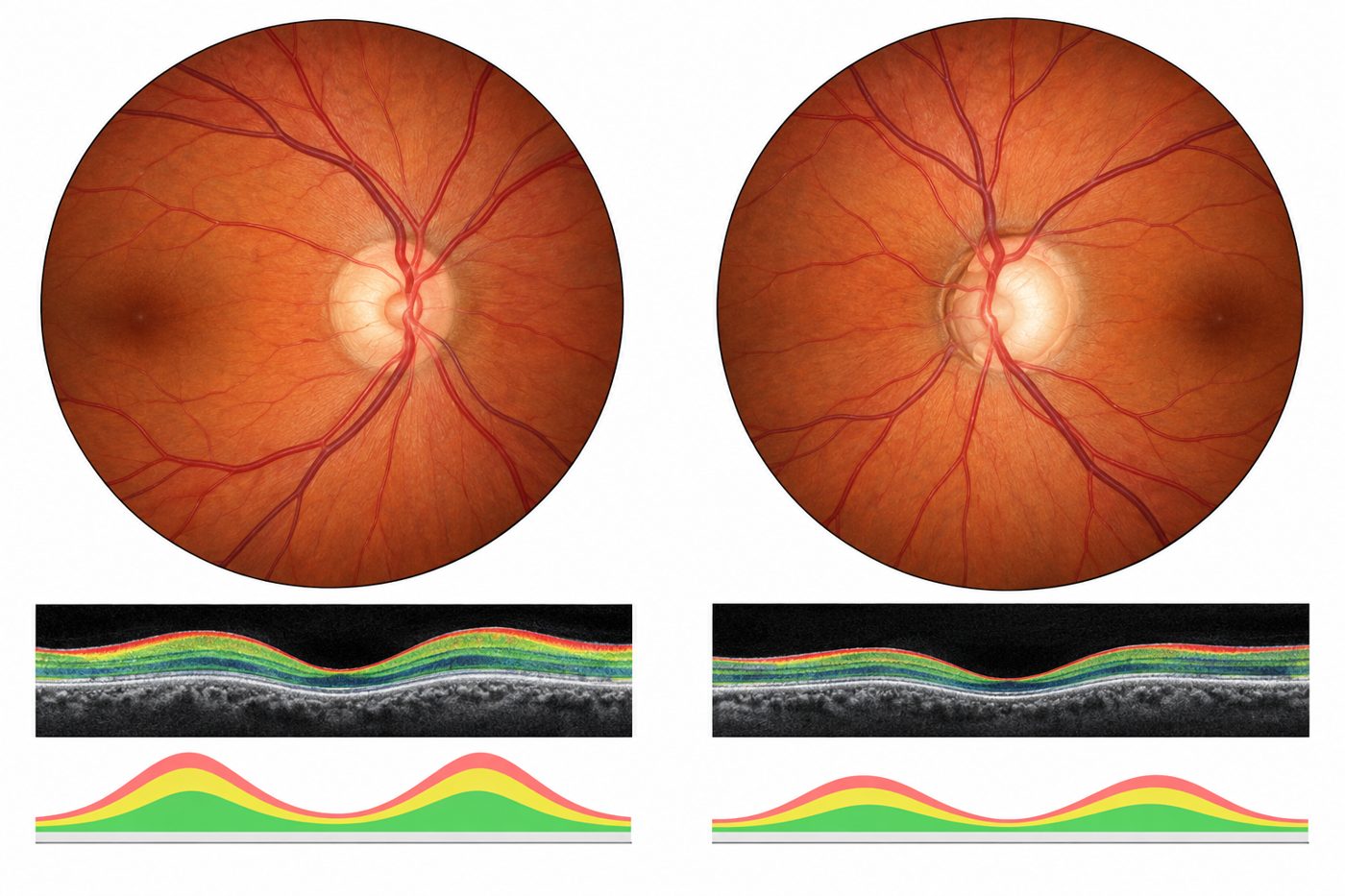
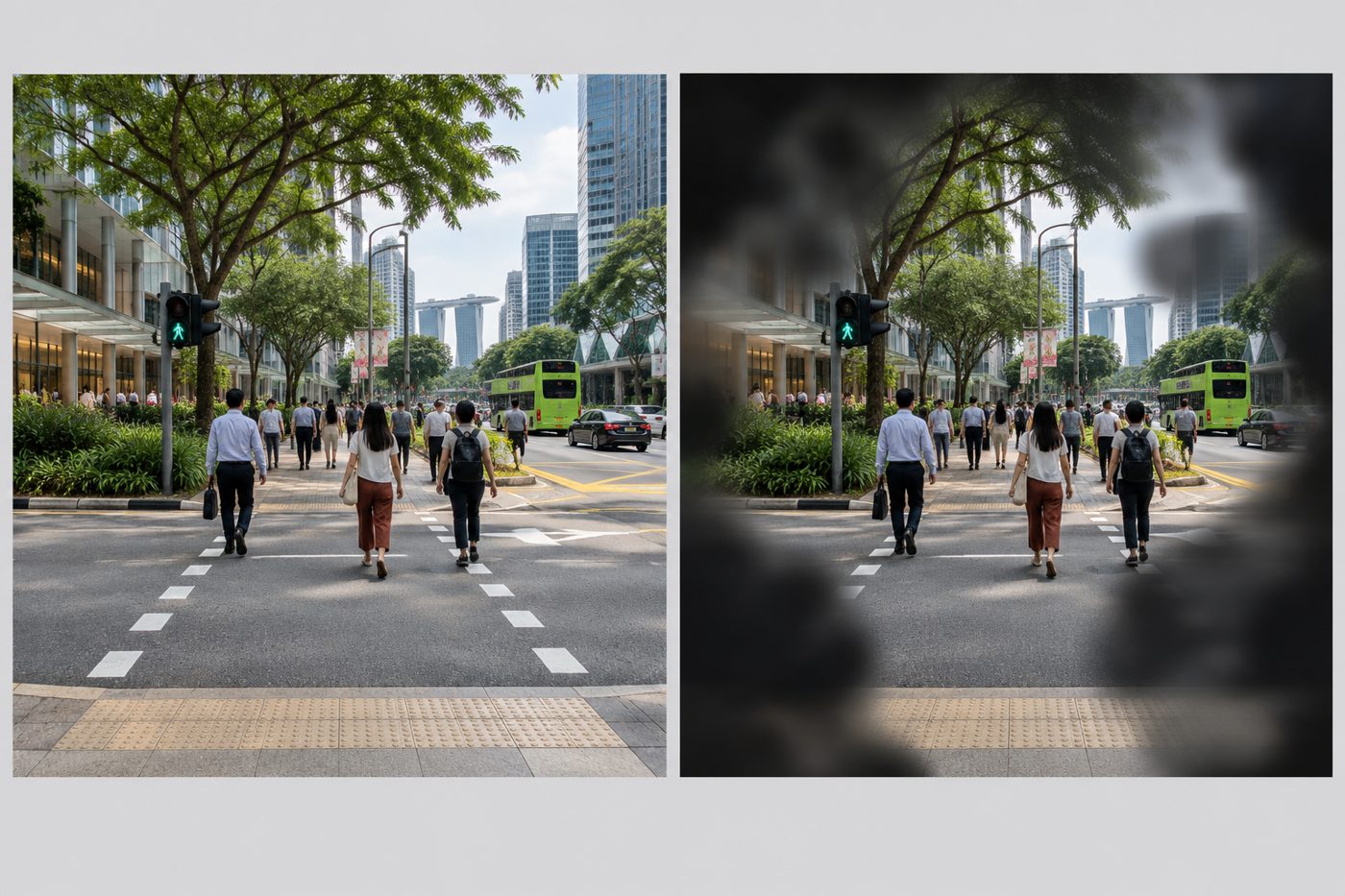
Glaucoma damages the optic nerve, the cable that carries information from the eye to the brain. In most types, it does this slowly and painlessly. It usually takes away side vision first, while your central vision stays sharp. So you can read the eye chart perfectly well and still have glaucoma.
Here is the hard part. The vision lost to glaucoma cannot be brought back. Treatment aims to stop or slow further damage. That’s why it is called the silent thief of sight, and why finding it early makes such a difference.
You might be thinking: “But my eyes feel fine.” That is exactly the point. With early glaucoma, they usually do.
What a proper 40s eye check should include
A quick vision test at an optical shop is useful for updating your spectacles. It’s not the same as a medical eye examination. At 40, I’d look for these:
- Vision and refraction. Your distance and near vision, and whether lao hua has started.
- Eye pressure. Raised pressure is a major risk factor for glaucoma. It’s only one piece of the puzzle, though. Many people with glaucoma have normal pressure readings.
- A look at the optic nerve. This is the key one for glaucoma. If there is any doubt, an OCT scan (a quick, painless scan of the nerve fibre layer) and a visual field test can give more detail.
- A look at the retina. Especially if you are myopic. We check for thinning areas or tears at the edges of the retina, and for changes at the macula, the centre of your vision.
- The front of the eye. Early cataract changes, dry eye, and whether the drainage angle of the eye is open or narrow.
Your eye doctor may dilate your pupils with drops to see the retina properly. If so, your vision will be blurry and light-sensitive for a few hours. Bring sunglasses, and please don’t drive yourself home.
“But I already do a health screening every year”
Good. Please keep doing it. Company and government health screenings are useful, and as the Straits Times report pointed out, better access to screening may be one reason glaucoma is being picked up earlier in Singapore.
But a screening is a quick sieve. It’s designed to catch the obvious things in a large number of people in a short time. A comprehensive eye examination is slower. It looks at the whole eye, compares both sides, and lets someone trained in eye disease look directly at your optic nerve and retina.
The same goes for a spectacle check at the optical shop. Your optometrist can pick up a lot, and will often refer you on if something looks unusual. Still, a new pair of glasses that makes the eye chart sharp doesn’t tell you much about your optic nerve.
Think of it as the difference between a quick car wash and a full servicing. Both have their place. Only one looks under the bonnet.
Who should not wait until 40
The baseline at 40 is for people with no risk factors. Some of you should be seen earlier, or more often:
- Family history of glaucoma. If a parent, brother or sister has glaucoma, your own risk is higher.
- High myopia. Particularly if you’ve worn thick lenses since school, even if you’ve since had laser vision correction.
- Diabetes or high blood pressure. Diabetes can damage the blood vessels of the retina. People with diabetes should have their eyes screened regularly, usually every year.
- Long-term steroid use, including steroid eye drops, inhalers or tablets, which can raise eye pressure in some people.
- A past eye injury.
How often after that?
That depends on what the baseline shows. For adults without risk factors, the American Academy of Ophthalmology suggests a check every two to four years between 40 and 54, and every one to three years between 55 and 64. If you have risk factors, or something needs watching, your eye doctor will set a shorter interval.
Don’t wait for your next check if you notice these
Some symptoms need attention within the day, not at your next routine appointment:
- Sudden blurring or loss of vision in one eye
- A sudden shower of new floaters, or flashes of light
- A shadow or curtain coming across part of your vision
- A red, painful eye with blurred vision, especially with headache, nausea or vomiting, or seeing haloes around lights
The last one can be a sign of acute angle-closure glaucoma, which is an emergency. Go to an eye doctor or the emergency department straight away.
A small step for your 40th year
Here is my suggestion. Don’t treat it as another chore. Treat it as a birthday present to your future self.
Book one proper eye examination this year. Before you go, ask your parents and siblings whether anyone has glaucoma, and bring your current glasses or your last prescription. If you’ve had laser vision correction, bring whatever records you have.
And if you’ve found yourself holding the menu at arm’s length at your birthday dinner, you’ll have something to ask about too.
Forty is a good age. Let’s keep your eyes good for the next forty years too.
About the author
Dr Philemon Huang is a Senior Consultant Ophthalmologist and Medical Director of OneVision Eye Specialist & LASIK Centre at Mount Elizabeth Medical Centre, Singapore. He holds MBBS (S’pore), MMed (Ophth), FAMS and FRCOphth, and completed a glaucoma fellowship at Sydney Eye Hospital and Westmead Hospital, Australia, under a Ministry of Health HMDP award. He was previously Head of Glaucoma Services at Khoo Teck Puat Hospital.
References
- American Academy of Ophthalmology. Get a Baseline Eye Exam at Age 40. aao.org
- American Academy of Ophthalmology. Eye Exams 101 / Frequency of Ocular Examinations. aao.org
- Singapore General Hospital. Presbyopia. sgh.com.sg
- More younger adults in Singapore developing glaucoma, likely because of untreated myopia. The Straits Times, 8 March 2026.
This article is for general education and does not replace an individual consultation, examination or diagnosis by a qualified ophthalmologist. If you have sudden changes in vision, flashes, new floaters or a painful red eye, seek urgent medical attention.